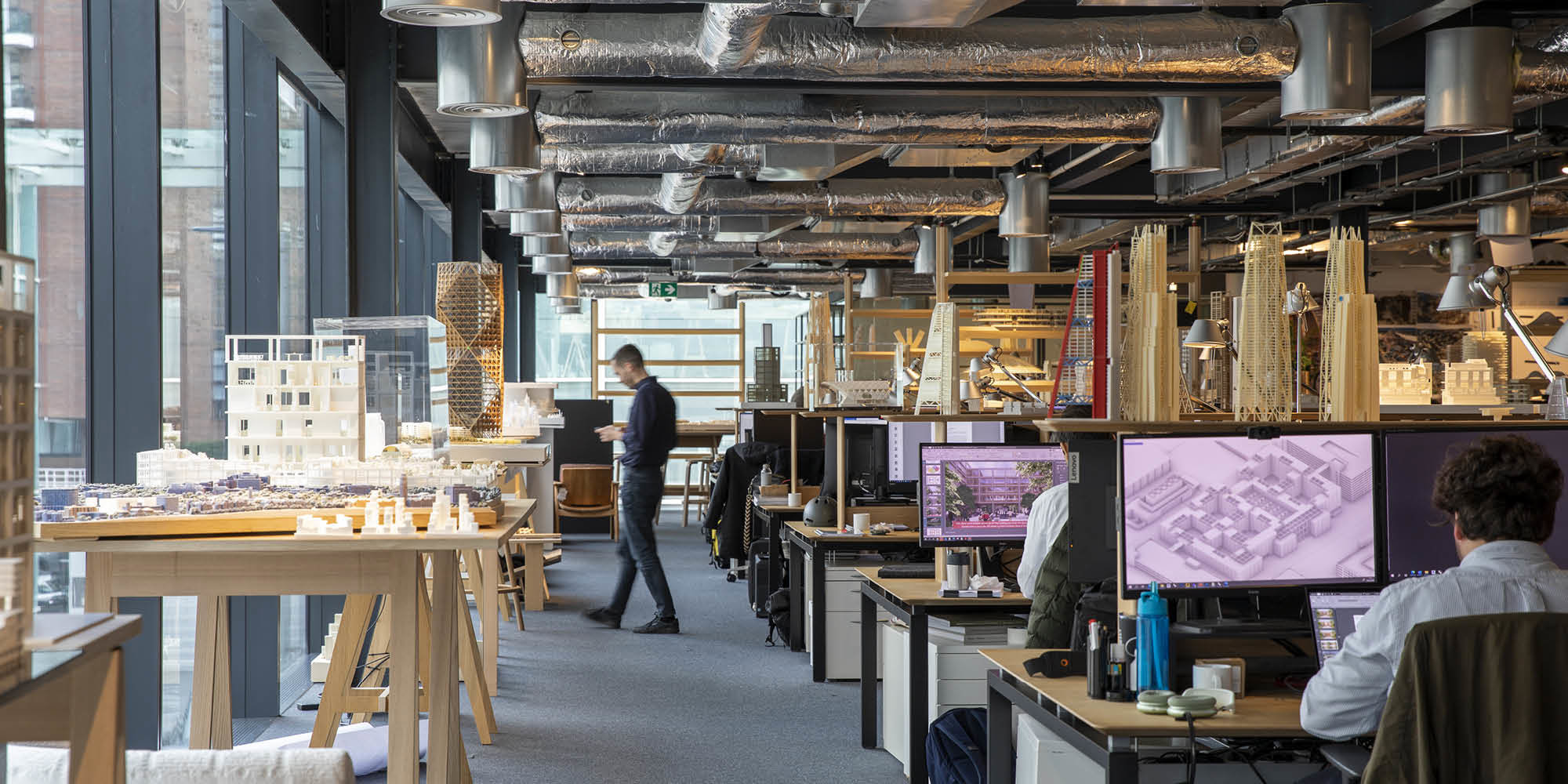
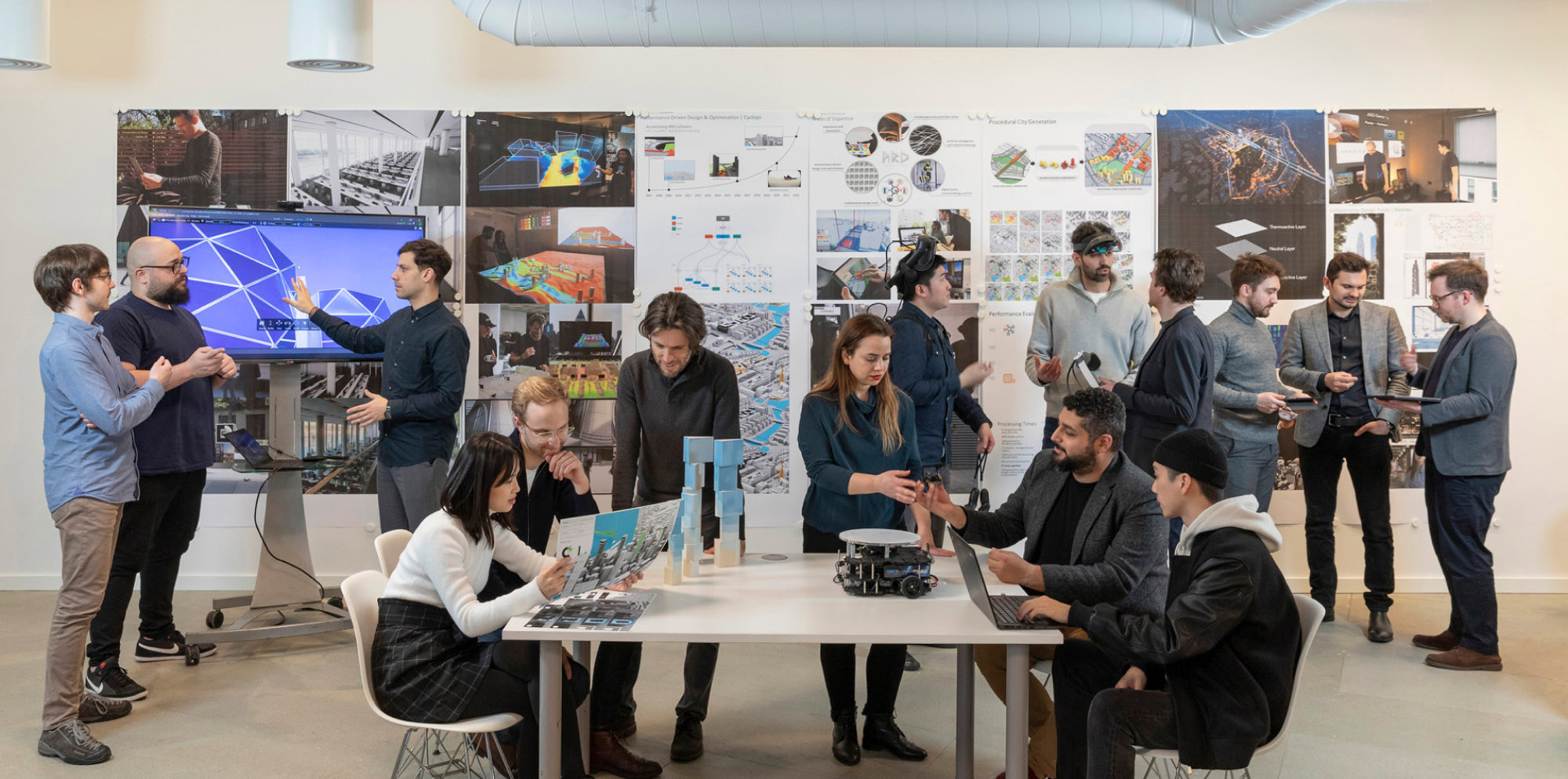
Office furniture, like the office itself, must be adaptable to changing work patterns. The Nomos concept is rooted in an earlier foray into furniture design. In 1981, when the practice expanded into a new studio, no existing furniture system could provide tables that were adjustable for meetings, drafting or display. The outcome was a custom-designed table (modified versions of which were used in the Renault Distribution Centre), made in a small production run by a sympathetic workshop. When the Italian furniture manufacturer Tecno subsequently commissioned the practice to develop the design, they required a system that could optimise floor space, accommodate cabling and be easily reconfigured.
The concept of Nomos (a Greek word meaning 'fair distribution') is based on the relationship between the users and the space they occupy. At the heart of the design is a kit of precision-engineered components that can be combined to create bespoke working environments for individuals or groups. The starting point is the spine, to which are added legs, feet, supports, work surfaces and superstructures, while a vertebra-like conduit carries cabling. With its characteristic splayed feet the desk is evocative of the Lunar Landing Module, or a grasshopper with its thin body and slim legs. Utilising this highly stable frame, the system can accommodate shelves, storage, screens, lighting and signage - an assembly governed by the ergonomics of the human form, seated or standing.
In 1999 Tecno commissioned a new table to mark the millennium. The rectangular and circular-topped tables are long-established favourites, but in the quest for another classic shape, smooth curves were investigated to encourage better eye contact across the table's length. In tune with this more informal approach, the primary frame is also expressed in a vivid palette - red, yellow or blue - with other elements in bright chrome, while a more classical option has a chrome frame with the secondary elements in black.
“One of the most notable aspects of the Foster Techno project has been the visibility collaborative nature of the work. ‘Their performance has been spectacular’, says Foster’s Martin Francis about Techno. ‘We would go to a meeting one week and return a week later to find they had already made a complicated prototype,. In ten days, they handmade 1 metre of spine’, Foster’s approach is also notable. The practice worked on the problem in the same way that hey designed a building … ‘This was our first venture into mass production’, explains Francis. ‘Although our buildings were a metaphor for mass production, they were in fact craft products.”Lance Knobel, Designers’ Journal, January 1987
“The Nomos system can be explained as a layering of zones determined by the ergonomics of sitting and standing, work and storage, lighting power and information.”Norman Foster
“I have chosen to express the Nomos frame in an extrovert way, like a bike, with a vivid palette of colours – a strong red, a vibrant yellow, a rich blue and a brilliant white.”Norman Foster
Appointment: 1987
Client: Tecno Spa.
Additional Consultants: Office Planning; Dieter Jaeger / Quickborner Team
Award